
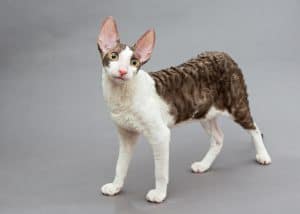
Appearance
The Cornish Rex has soft, wavy, rippled coats that lack guard hairs and don’t shed like other cats. This means that the Cornish Rex requires very little grooming and doesn’t deposit hair all over the house. This also means that this cat breed is one to consider if you are an allergy sufferer. More Reading: Hypoallergenic Cat Breeds
The Cornish Rex has been compared to the Whippet dog because of its slender athletic build, curved contours, arched back, and willowy body. From torso to tail, the Cornish Rex is long and lean. Do not let the willowy form fool you-the. Under that ultra-short fur are strong bones and muscles. Cornish Rex is no weakling.

The defining characteristic of the breed, however, is its very short, close-lying, soft wavy fur. The entire coat is curly or wavy, sometimes compared to the design of a washboard. They have a marcel wave.
Although completely lacking guard hairs- the long, stiff, outer hairs that act as a barrier against the elements- the Cornish Rex’s coat is made up of the soft inner down and awn hairs, with down hair predominating.
The lack of guard hairs makes the Cornish Rex’s coat a very soft touch. The soft, warm feel is luxurious. Fanciers often compare the feeling of the Cornish with warm suede or crushed velvet.
Personality
The Cornish Rex cat is delightful, distinctively different, constantly charming and captivating. Even-tempered, affectionate, and people-oriented, they also appeal because of their hushed voices. Once seen, never forgotten.
They are also active cats whose kitten-like antics last their lifetime and can be very inventive in their play.
The Cornish Rex is one of the few breeds that enjoy the crowds and excitement at a cat show. Where other cats are frightened or annoyed by the many onlookers and the noise, the Cornish Rex watches with interest. They like people, and they also want to participate in their activities.

Give a Cornish Rex a piece of string and watch it go into action. Its movements are, like its very body, a study in curves as it jumps, dances and rises on its hind legs. Using its paws like hands, a Cornish Rex can pick up small objects; some have even learned to turn door knobs and open doors.
Its keen intelligence is observable through its alert interest in people and their antics. Yet the same Rex who has just been gracefully flying through the air will be delighted to cuddle up on its owner’s lap or, even better, right under his chin.
Indeed a study in contrasts, a Cornish Rex is one of the most versatile pets with a mood to match every occasion- it is truly a cat for all seasons.
Living Needs
Rexes need people and, given a choice, will spend most of their time with humans. This is partly due to their desire for warmth. When they are free to choose their sleeping quarters, their first choice is the owner’s bed.
An active cat who loves to exercise, it has no problems creating its entertainment. While most mature cats outgrow their kittenish playfulness, a Cornish Rex never loses interest in games and, as an adult, is as playful as a kitten.

Because it is active and likes to participate in all household goings-on, the Cornish will make their feelings known when not paid the proper amount of attention.
The Cornish Rex loves heat and will get as close as possible to its source. If your home has electric baseboard heat, your Rex will spend winter days sitting right on top of the heater, and in summer, will enjoy basking in the sun even during the hottest part of the day.
Care
Despite its delicate appearance, the Cornish Rex is a surprisingly hardy breed and does not require any unusual care. The coat requires very little grooming.
They do not shed like other breeds, but their short, fine hair is hard to see, and they don’t deposit their hair over the furniture like other animals.

The Cornish Rex does not take well to being caged. When raised in confinement without close human contact, Cornish Rex loses their zest for life. Their coat becomes dull, the curl disappears, and they pine away. To be a family member with a free run of the house represents the best life for a Rex.
Breed History
The discovery of the Rex mutant gene in farm cats from Cornwell, England, in the early 1950s was undoubtedly the most exciting event in the cat world this century.
In a relatively short time, the breed has gone from strength to strength, with the Cornish Rex cats making their presence felt on the show bench. The Cornish are taking their fair share of Best in Show awards and are forcing the Cat Fancy to ‘sit up and take notice!